
Guidelines for Adopting AI Tools and Practices
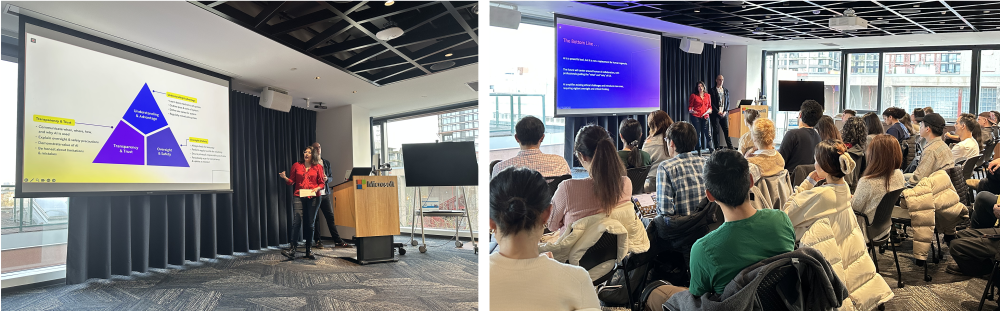
We recently delivered a presentation at VanUE entitled ‘Can robots do your job?’ where we laid out a framework for implementing AI into your work. This framework comes from our background as UX consultants and findings from our comparative research on humans vs AI. From this experience, we've found that there are few key things to consider when it comes to working with AI.
AI is a powerful tool, but it is not a replacement for human ingenuity.
AI excels in basic brainstorming and managing repetitive tasks, however its effectiveness still relies heavily on humans for strategic direction. This is ok though, because AI does free up time from other things and that time can be used to craft the prompts and provide the input needed to successfully harness the power of AI.
The future of AI will center around collaboration, with professionals guiding the "what" and "why."
While we will likely see a shift towards more dynamic and multimodal AI interfaces, beyond traditional text-based tools, experts will still be needed to ensure meaningful products and services. The “how” of our work may become more and more automated, but the purpose will still be rooted in the human experience.
AI amplifies existing ethical challenges and introduces new ones, requiring vigilant oversight and critical thinking.
Just as people are inherently biased, AI can also be skewed by biases in training data or inappropriate application of tools, potentially perpetuating stereotypes or limiting perspectives. And, hallucinations and environmental impacts are also real concerns regarding the use of AI.
So, this brings us to our framework for using AI…
AI FRAMEWORK
We developed this framework to help determine if you should use AI, which tool you should use, and how you should use it.
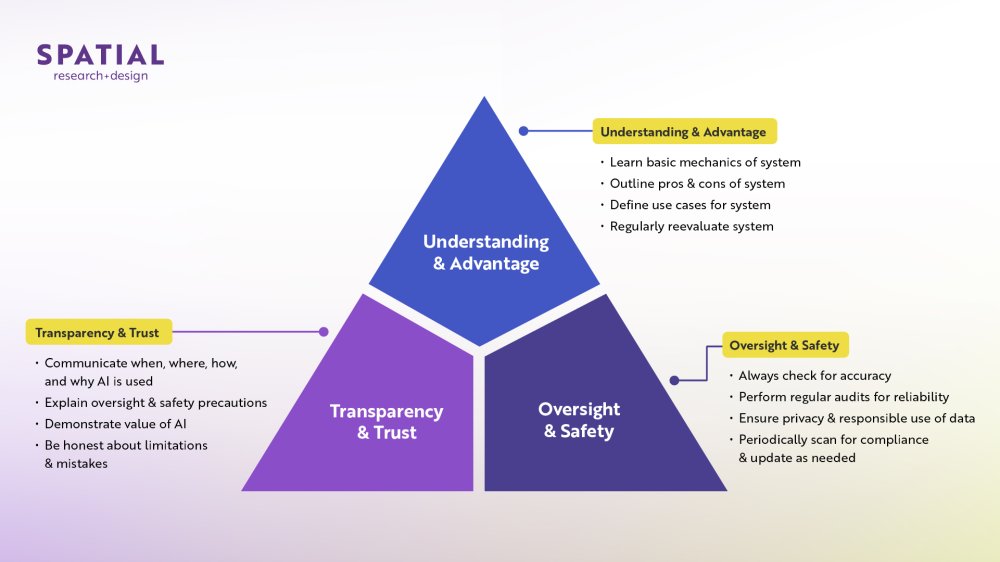
Understanding & Advantage
What is the reason for using AI and this tool in particular?
- Learn basic mechanics of system. How does it actually work?
- Outline pros & cons of system. Maybe it uses a lot of energy – that’s an environmental con you might consider
- Define use cases for system.
- Regularly reevaluate system. Keep informed of any changes to the system to make sure it still makes sense to use it
Oversight & Safety
Is this AI tool actually doing alright?
- Always check for accuracy. Does the data actually support the findings or is it making stuff up?
- Perform regular audits for reliability. Is it still doing what it’s supposed to be doing?
- Ensure privacy & responsible use of data. Do not release personal info or proprietary knowledge into the wild
- Periodically scan for compliance & update as needed.
Transparency & Trust
Your team should know you’re using AI. Just as you would describe your process and decisions when working without AI, do the same when working with AI.
- Communicate when, where, how, and why AI is used.
- Explain oversight & safety precautions. Explain oversight & safety precautions
- Demonstrate value of AI.
- Be honest about limitations & mistakes. Just put it out there, here’s what it can and can’t do
CONCLUSION
These components are all equally important and they also complement each other. You can’t just have one without the other and these aren’t steps in a linear process, it’s an ongoing commitment to professionalism and doing the right thing, just like you probably, hopefully have with yourself and your team now.
And, if you’re still wondering about the question, ‘Can robots do your job?’ The answer is, ‘Probably some of it, but definitely not all of it.'
Special Thanks
We’d also like to give a big thank you to Matthias Klenk and Mahsa Karimi for their contributions!